
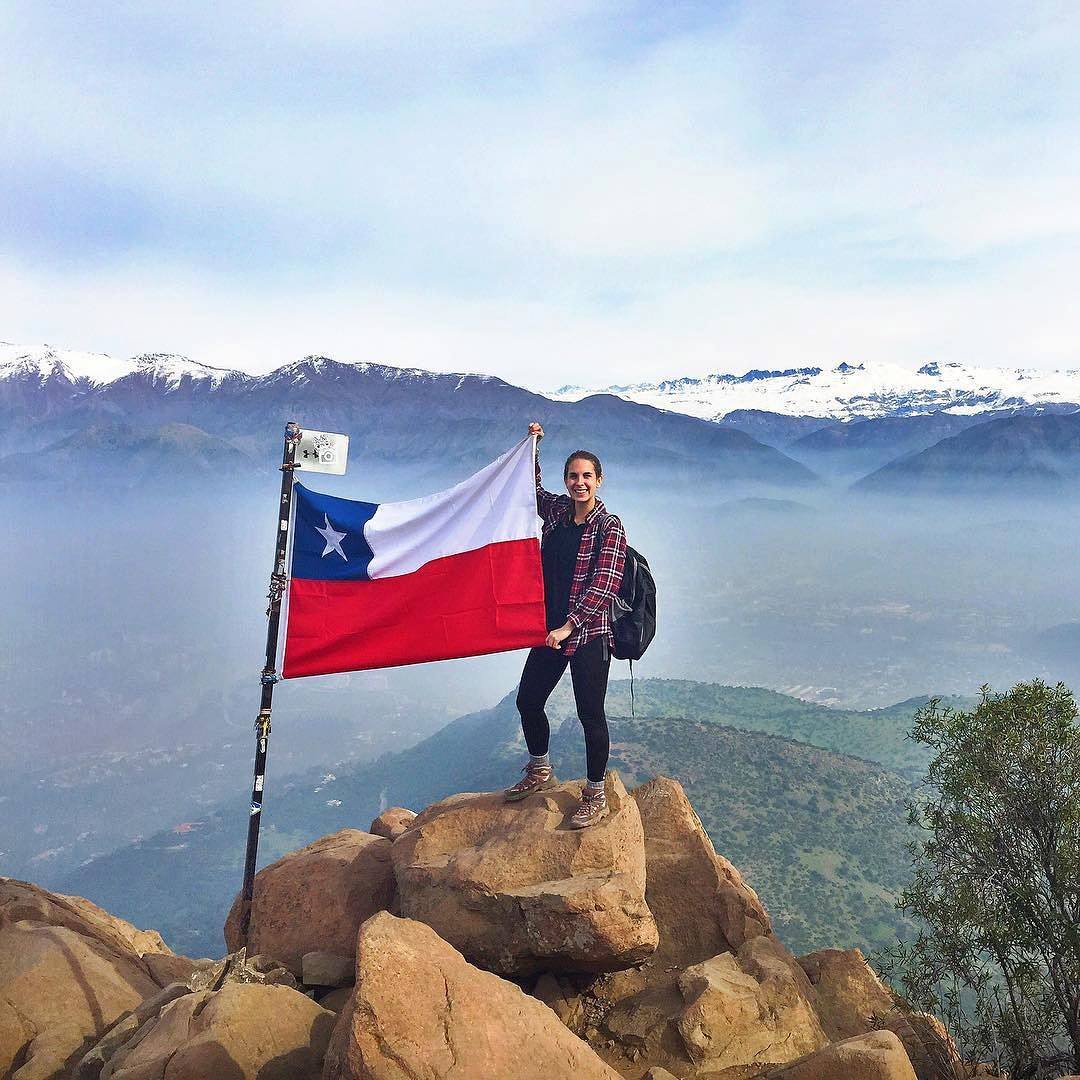
If you read my “Shocking in Santiago” post a few weeks back, you already know that quite a few things surprised me about life here in Santiago. Weirdly though, one thing that slipped my mind and I totally forgot to add to the list, which really shocked me the most, was the language & all those pesky Chilean slang words.
Before moving to Chile, I had heard many a tale of the strange language known as ‘Chileno,’ or the Chilean version of Spanish. Still, I figured after 2 years living in Spain, it couldn’t possibly be that bad…
Wrong.
My first memory after plane touchdown in Santiago goes a little something like this: It’s 8 AM after an overnight 10 hour flight. My friend Mandy and I have finally made it through customs, collected our bags and are head towards the airport exit. We are very eager to get to our hostel, so we quickly make our way over to the Transvip transfer desk and begin to converse with the attendant. Ten long minutes and a lot of confusion later (note– our transfer had already been arranged, confirmed and paid for in advance) Mandy and I exchange a puzzled glance- this whole Chilean slang / language thing was definitely going to be harder than expected.
After similar interactions with our driver and several vendors on the street, I finally knew what all the fuss was about. This “Chilean Spanish” was hardly Spanish at all!
Anyway- long story short, I could dedicate an entire website to the art of ‘Chileno‘ and these ‘Chilenismos,’ or Chilean slang words. Actually, there are many dictionaries, books and Youtube spoofs dedicated specifically to the topic.
BUT for today, I figured we’d start slow and I’d help you get your feet wet.
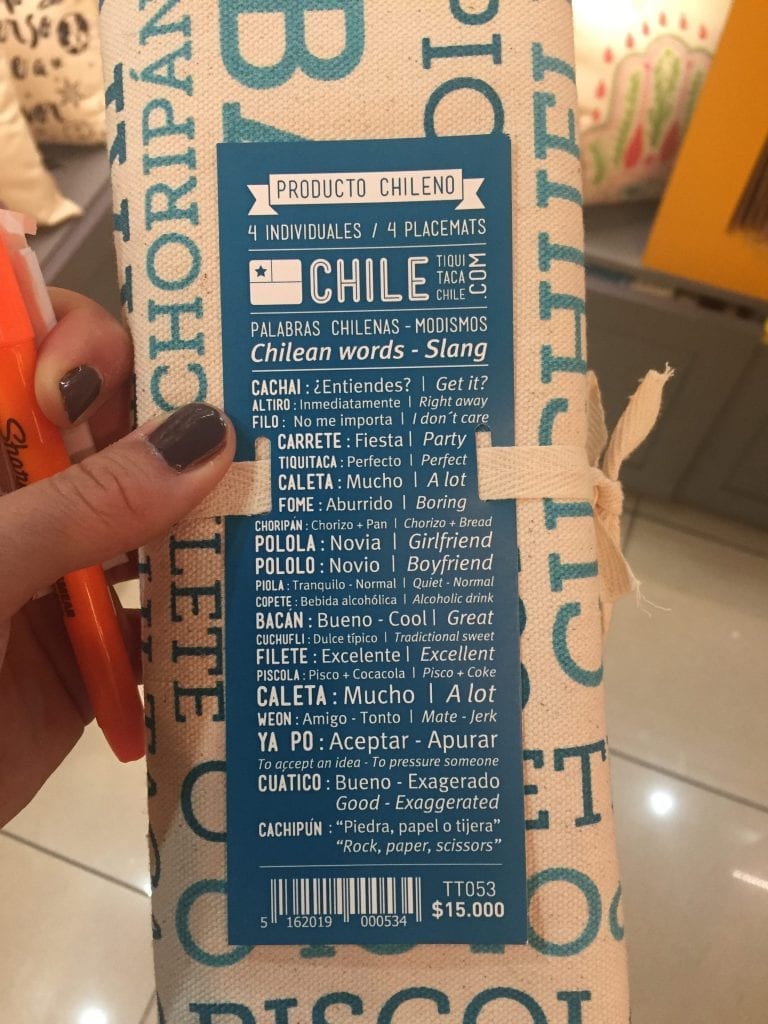
Here are 10 of the most common Chilenismos, that you’re sure to hear pretty much any time a Chilean opens their mouth. If you want to become a part of any conversation in Chile, be sure to go armed with these slang words, and if you don’t plan on talking to any Chileans in the near future- well, here’s to hoping you still learn something!
Interested in learning more about this South American gem? Check out these 15 interesting facts about Chile.
The 10 Most Common Chilenismos or Chilean Slang Words
1. Chachai? – You catch that?
‘Chachai‘ is usually used at the end of a sentence or question to check that someone understood what you were saying. It pretty much means:
‘You get me?’ or ‘You know?’

2. Fome – Lame or Boring
Fome means that something is ‘not cool,’ or “lame” / “boring.” You’ll often hear the phrase- ‘que fome,’ or how boring! One I got pretty much anytime I did a ‘not so exciting’ activity at school last year..
3. Bacán – Cool
Bacán is another one that’s used in pretty much any casual Chilean conversation. Well, as long as there’s something ‘cool’ to talk about.
4. Cuico / Cuica – Posh or Preppy
Chileans use ‘Cuico‘ or ‘Cuica‘ to talk about people with money. Most of the time it’s used for more than just money though; it’s also the attitude that comes along with it. Depending on the context, it can mean stuck up or snobbish. Every Spanish speaking culture seems to have their own version of this- back in Spain it was “pijo(a).”

5. Weón / Weóna – Dude
Gosh, where do I start with weón. Or should I say ‘hue’on’ or even ‘huevón.’ This is such a loaded word, with so many meanings in so many different situations. One thing’s for sure, you should be careful how you use it.
Depending on the tone of your voice, the context and even who you are talking to, this word can mean SO many different things. BUT for reasons of keeping these explanations short and to the point- we’ll say it means something along the lines of dude. It can also mean friend, idiot, jerk, loser, player, clown, and well, the list goes on and on.
You’ll also hear the words ‘hue’a’ or ‘wea’ thrown around pretty loosely. This is used to refer to a thing, a situation or even something abstract. Used correctly, wea can pretty much mean anything you want it to. Good or bad.

6. Pololo / Polola – Boyfriend or Girlfriend
Finally, one with a simple explanation. Pololo and Polola would have to be a set of my favorite Chilean words. The first few times you say it, it just sounds so freakin’ ridiculous. Go ahead, say it, I dare you …
Pololo and Polola mean boyfriend and girlfriend and you can also use it as a verb- ‘pololear.’ So, if you say ‘están pololeando‘ (which I suggest you do because it sounds hysterical), you’d be saying- they’re dating or they’re seeing each other.
Be careful, because ‘novio‘ and ‘novia’ AKA the more universal Spanish words for boyfriend and girlfriend mean fiancé here in Chile! Can definitely get you into some interesting situations 😂
7. Carrete – Party
Apparently, “fiestas” aren’t good enough for my dear Chileans. 😂 Chileans prefer carretes. In verb form the word’s ‘carretear.’
An example of how to use it- ‘Vas a carretear esta noche?’ – You going out tonight?
8. Cuático (a) / Brígido (a) – Wow, Whoa, and a whole lot of other things
Cuático and brígido are pretty much interchangeable but completely dependent on the context. Even more so than weón. Most of the time, you use these words to describe something shocking- either good or bad. They can mean anything from weird, great, exaggerated, incredible, horrible, and pretty much anything in between.
Sorry if you were looking for a simpler answer…

9. Piola – Calm or Relaxed
‘Piola’ is used as an adjective to describe something, someone or a situation as normal, indistinct or not particularly out of the ordinary. Basically, when something’s not explicitly great or overly horrible, it’s just ‘piola.’
Piola can also be be used to describe a person. If a person is piola, they’re calm, relaxed and don’t cause problems. They might even be quiet or shy. They pretty much just fly under the radar.
10. Caleta – Too much or A lot of
Caleta is used to say- a lot of, too much or a large amount of something. It’s used ALL the time. I guess Chileans like things in big quantities.
As you’ll see in my video below, my friend used this example- ‘Lauren comió caleta hoy,” or “Lauren ate too much today.” Yeah, I know, story of my life…
For explanation’s sake, I’ll give my own example- “Chilenos usan la palabra ‘caleta’ caleta,” or “Chileans use the word ‘caleta’ way too much.” Yeah I know, corny, but it works.
BONUS CHILEAN SLANG WORD – ‘Po’
Well, I guess I kind of tricked ya, because ‘po‘ or ‘poh‘ isn’t really a word at all. It’s just a kind of space filler. Chileans will attach ‘po’ onto the end of any word or sentence, but mostly you’ll hear something along these lines – ‘sí po,’ ‘no po,’ or ‘ya po.’ But like I said, Chileans toss around ‘po’ more than your dog’s favorite chew toy. Add it to your Chilean vocabulary and it’s sure to be a crowd pleaser.

And not only do Chileans love slang, but they also LOVE Memes and Gifs … yeah, these peeps are really starting to wear off on me …
Oh yeah, and for a video of some of my Chilean friends explaining this crazy Chilean slang in their own words, check out this video!!
Which of the above words was your favorite? Have you ever heard of Chilean Slang?
Sharing is caring! Pin this post and save it for later!



Love this! I can only order a cooked breakfast in Spanish so this slang is all new to me. My spanish accent is horrendous so I think I’ll stick with chachai because I reckon even I could pronounce that! I teach English to international students and I love teaching slang but the students always find it so confusing! The good thing is once you master some slang, you can speak the lingo like a boss!
Many of these are funny! This reminds me I really should start learning some Bavarian or German slang…I’ve been here 5 years and haven’t caught much of it! #WanderfulWednesday
These are all spot on! All of these words are normal to me as I never learnt Spanish before Chile, ha! And my favourite has to be pololo, i just love how it sounds!
Speaking NO Spanish, these are all new for me lol. But I had a similar experience last week meeting someone who speaks English “cockney” … I’ve lived in England for years and figure I have the slang down pat, but I had NO CLUE what she was saying haha.
I love learning about the little mannerisms and slang words that are common in an area. It definitely gives a little more flavor and personality to the places I travel to. #wanderfulwednesday
What a fun post! I don’t have a trip to Chile planned in the near future but definitely saving this for when I do someday. 🙂 #WanderfulWednesday
Love this! I’ll be in Chile next month, already heard Chilean Spanish is quite different so I might struggle a bit!
(How fast do Chileans speak?)
Interesting to know! There are many mannerism in Greece to depending on the region (specially Northern Greece and Crete)
I’m laughing so much! Spanish is SO different between countries and even within the country! We also say huevon but it usually means lazy, or que hueva which means boring. And our poh is pues, but some people say pos, or pueh. Aaaaah, this is just so crazy. The pololeando has me in stiches, btw. I cant even pronounce it!
Never heard any Chilean slang (but I watch the Dakar so maybe I have and just didn’t understand it!) but I just started learning Finnish and one of the fist words you learn is ‘Cheers’. Thought that sounded very civilised. I think I’ll like Finland.
Getting an understanding of slang is the hardest part of learning a language but also the best! I have so much fun laughing at weird things that Germans say. One of my favourites is ‘Alter’ which, translated literally, is ‘old man’, but means something along the lines of bro!
Brilliant! What a great guide. Honestly, it’s so hard when you’ve learnt a language, but when you travel to that country suddenly it doesn’t seem to make sense – because of all the slang and local dialects! Definitely the hardest part of learning a language.
Wow. I never thought about this. Must be how new languages come into existence. Your guide will be remembered when I make it to Santiago late next year
For a Spanish speaker (not from Chile), this is completely hilarious and confusing at the same time. I guess I would be very lost in Chile. We spent some time with Chilean friends and we were a bit puzzled but there were several funny moments. Actually, learning the words used at other Spanish speaking countries is one of my favorite things to do. #WanderfulWednesday
This is so interesting! Norway has many different dialects but luckily, most of the words are the same and it’s just the pronounciation that changes (a lot though). Are you afraid that you one day visit Spain and use Chilean slang without even realizing it and then no one understands you there? That would totally happen to me 😀
I took Spanish throughout high school and went to Spain on a foreign language trip and it was tough! It was only then that I learned just how many different tongues of Spanish there are. I can imagine how tough it must of been for you to learn the language and slang!
Kaitlyn | http://www.oh-theplaceswellgo.com
I love posts like this! The thing I noticed when I was in Chile is that they often drop the syllable of a word. It confused me so much. Or they’d make a word into the baby version by putting “ita” after it!
So funny how languages can be different between countries that, in theory, speak the same language. I love Chachai…and it’s a word I could use, because #teenagers in the house… 😉
I can totally relate to this post!Rewarding information, the best part is about word-po, i like it!
It’s rude of you to say that words from Spain are “normal”. No one says that American English is bad English or “wrong” English compared to the Brits. Or the Australians and Canadians fro that matter. If Latin American countries weren’t so adamant on the whole Latin identity, half of these Spanish dialects could become full fledged languages if they didn’t follow the rules for grammar and orthography from Spain
Thank you for this Stacey. I wrote this post a long time ago and reading it over again now, my use of “normal” seems to have been intended to add some comic appeal to the post, but you’re right, it’s rude. I’ve now lived in different Spanish-speaking countries and learned different dialects and ways to say things, and often times Spain is actually the outlier. Thank you for bringing this to my attention. I’ve removed the word “normal” and am going to re-read this full post and update it in the near future.
The slang chachai is not right. The correct word is “CACHAI” because this word come from the english word ‘catch’